.png)


After Happily Ever After

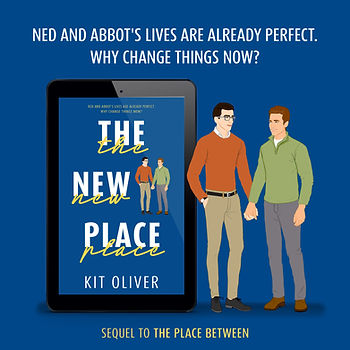
What happens after the final kiss in a romance? After everyone says 'I love you' and the last page is turned?
For Ned and Abbot at the end of 'The Place Between', it means walking back to Abbot's house and presumably spending the rest of their weekend banging it out.
And then?
Well, Monday comes and they head back to work. Over on my Patreon, I posted in detail what I think their spring semester will look like, though to be fair, I wrote that back in 2023 when 'The New Place' was just a funny idea that maybe I would write someday. And yet, even years before I would begin work on this book, I was clearly interested in their future and beginning to consider what Ned and Abbot's 'happily ever after' might consist of.
Because that's really what gets me thinking: what is a 'happily ever after?' Most love stories end at the very beginning of a couple's journey. We watch two people fall for each other, share their first kiss, grow terrified of the strength of their feelings, and eventually realize that they're it for each other. The two lovebirds come together at last, the music swells, the scene fades to black and I'm sitting here like hmmmm, I wonder what their first fight is about? Because we all know that the honeymoon stage doesn't last forever, and in most romances, our journey stops right in that glowy bubble of happiness... Except that life keeps trucking along, and that is exactly what I wanted to write about when I sat down to tackle 'The New Place'. It felt like a real adventure to break into the second part of Ned and Abbot's story, since I'm so used to writing that initial 'getting together' phase of a couple. What story beats would a sequel follow? Where's the blueprint of the genre I had learned so well with 'The Place Between' and 'Cattle Stop', and 'Light Up the Lamp'? How do I work with my typical process when this book was so completely different?
Basically, I didn't. I just went in with a hope and a dream and the terrified confidence I could pull this off. The sequel took its own shape as romance-genre adjacent, but not really exactly the same structure as I expected. For instance, we didn't have a meet cute, or in the case of Ned and Abbot who already knew each other in the beginning of 'The Place Between', the moment of a spark of real attraction and interest. Nor did we have the tension that kept them apart as a couple (namely their antagonistic professor/student relationship and general 'dislike' of each other in their first book), because they already were very much a couple. We don't have a first kiss, or the first time they sleep together, or meeting each other's friends or family, or getting to know the other better. All of that was behind them, and instead we had the warm comfort of an ongoing relationship where everyone had settled in and the shine of newness had worn off a bit.
So what the heck was I supposed to write about? I needed stakes: ok, Ned losing his job. I needed tension: ok, Abbot reluctant to share about his past and Ned reticent to reveal the full extent of his financial woes. I needed a way for them both to grow over the course of the book: ok, Abbot learning to open up, and Ned learning to trust again. I also needed a plot, which I had in hand: Adams closing, the pursuit of a spousal hire, and the ensuing shenanigans of trying to 'prove' to Beverly/Newbury/HR that they are 'together' enough for Ned to receive a job offer.
But putting this all together felt odd as heck. How do we have a third act breakup when I'm absolutely never breaking this couple apart? What happens when instead of the newness of sleeping together for the first time, we have boring weeknight sex?
And that, I realized, is exactly where the fun is. I couldn't write about the excitement of seeing each other naked for the first time, but I could delve into what happens when Baxter needs to go out and Ned and Abbot are about to get their jollies off. This mundanity was precisely what I got to lean into, and if we gave up the thrill of newness, we gained the joy of familiarity, and also the very fact that we can see their relationship tested without letting it break beneath the strain.
So what I did was take the overarching shape of a romance book and begun to twist all those story beats into something new. Instead of a meet-cute, we have Ned hurrying up to Portland to surprise Abbot. If we typically have a character putting on the brakes as to why they can't be with/fall for their love interest, here in 'The New Place', we have Ned sure he can't move in with Abbot, and we have Abbot unwilling to share the depth of his emotions. Instead of a midpoint where the characters soften towards each other despite their reservations, we have Ned and Abbot sharing their 'engagement' with their families, and their own realization of their burgeoning happiness. And instead of that breakup we see in so many romances, we have both Ned and Abbot retreating into themselves after their wedding, and only through scenes with other characters do they realize how to come back together, and how very difficult that conversation is going to be.
Because at the end of the day, I wanted this book to really be about how relationships are hard work, and no matter how satisfying that first 'I love you' can be, every couple in a romance story has a long road ahead of them of compromise and communication and the difficulties of opening up your life to fit another person. I let Claire in Chapter 17 bring us the dialogue that I used as my 'thesis' for this book: “And it’s one thing to have fun and another entirely to build something together.” We typically get to see the fun part of a couple falling in love, and we rarely see what comes after. And, as a writer, until I sat down to work on 'The New Place', I got the fun part of writing a love story, without having to stretch myself to figure out how to write the sequel.
It worked. I love this book. I am so incredibly proud of how it turned out and the effort I put into it. 'The New Place' absolutely made me a better writer by forcing me to grow in ways that were painful and hard and exciting and confusing. It's still a romance book, and perhaps even more so, it's a love story. Above all else, it's a reflection on how two people need to continue to grow and work on themselves, and how that can be hard and scary, but also wonderfully necessary. And for me, it was an exercise in diving into the deep end of a scary idea I wasn't sure I had the skill to write, and figured my way through by the work of sitting down every day at my keyboard.
So thank you to Ned and Abbot for showing me - again - that it's ok to be scared, and to do the hard thing anyway. And, I suppose, for also putting the wild idea into my head that now I want to write sequels for all my books...

Comments